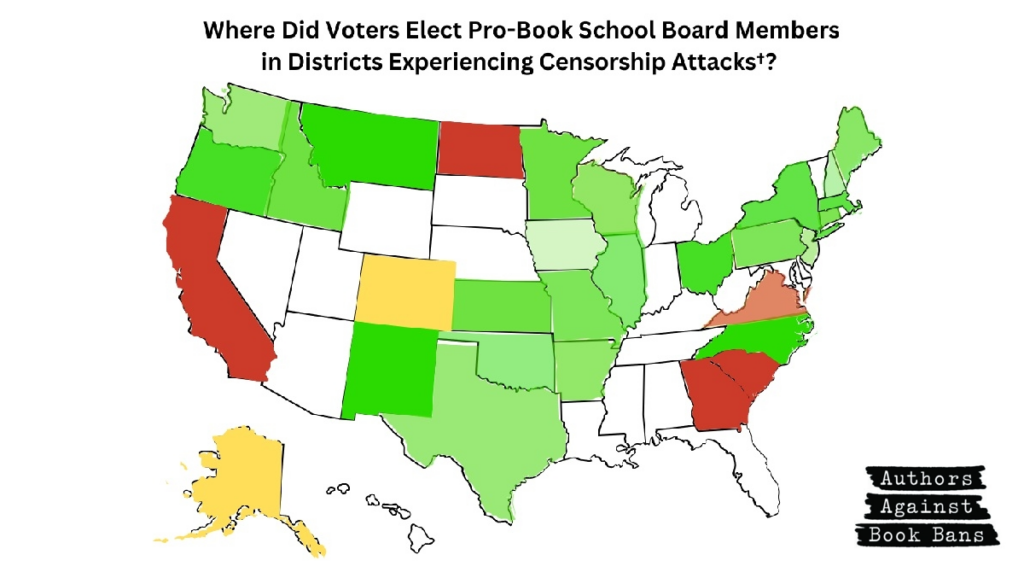
ϯCensorship attacks are attempts (successful or unsuccessful) to restrict or remove access to books based on objections to the book’s content. Map Key: Red = Majority of winners are unlikely/less likely to support the freedom to read; Yellow = 50/50; Green = Majority of winners are likely/more likely to support the freedom to read.
This blog post is by Susan Metallo, YA author, librarian, and response team member of Authors Against Book Bans, a Unite Against Book Bans partner
School Board Members Hold Power: Find Out Who They Are
“I never know how to find information on school board candidates,” a fellow author confided in me when I shared Authors Against Book Bans’ “Candidate Scorecards” for her local school district elections. Like many voters I’d spoken to, she felt grateful for the guidance since school boards play a crucial role in children’s access to books. That’s why AABB made scorecards: to help concerned voters respond to local book banning efforts at the ballot box.
Avoid Assumptions: Research Candidates’ Positions
Whether races are partisan or non-partisan, we need to research candidates’ positions and not guess based on their political affiliations or stated platforms, which often consist of vague phrases like “academic achievement” and “fiscal responsibility.”
As I dug deeper to understand the 2025 school board election landscape, I used several criteria to identify candidates most likely to support the freedom to read. When researching your local candidates, look for:
- statements made in candidate forums and on social media about books or book ban-related buzz words (e.g., “woke indoctrination”);
- endorsements or campaign donations from pro-book or anti-book sources; and
- incumbent board member voting records.
2025 Board Election Results in Communities that Faced Censorship
After the elections, I analyzed the outcomes in districts where AABB had a record of censorship attacks.* The resulting 330-district sample gives a heartening snapshot of Americans’ commitment to free speech. In 3 out of 4 districts nationwide, the majority of school board seats went to the candidates most likely to support the freedom to read.

Some victories were particularly galvanizing, such as in Bucks County, PA and Cypress-Fairbanks, TX, where infamously anti-book school boards flipped to pro-book majorities. Some candidates won by impressive margins, such as in Blue Valley, KS (20-32 pts); Las Cruces, NM (18-30 pts); and Loudoun County, VA (10-29 pts). In these districts where book bans were a hot-button issue, voters actively, emphatically rejected censorship.
With so many victories, even in states like Texas and Iowa with book-censoring state laws, why did 25% of the districts I studied vote anti-book? In part, because my study focused on districts with challenges—districts where citizens or elected officials already leaned toward censorship. But I also wonder how many voters unintentionally supported anti-book candidates because they didn’t know how to find the right information.
Know Your Candidates, Share What Your Learn, & Make Your Voice Heard
As your local school board elections approach this year, you can search your county, city, or school district’s website for candidates’ financial disclosures. Candidates frequently have Facebook pages which share endorsements, and candidate forums may be posted online. Or just reach out to the campaign and ask about book bans! (The Unite Against Book Bans sample candidate questionnaire might help.) Dig a little, then share your findings with your community—because information is power. After all, that’s why we fight this fight.
*Censorship attacks are attempts (successful or unsuccessful) to restrict or remove access to books based on objections to the book’s content. They may be conducted by parents, school staff, administrators, community members, and politicians and represented an effort to bypass or subvert the existing processes of book selection and reconsideration that are overseen by professional librarians and educators according to established professional standards. (An individual parent removing access to a book for their own child is not considered a censorship attack.)