
ABOVE: Bestselling, award winning, and frequently banned author George M. Johnson reads from his forthcoming memoir, And If I Die Before I Wake (Farrar, Straus and Giroux (BYR)), in the Big Chair at ALA in Chicago. Photo credit: Sage
This blog post is by Jonathan Fugger, Corporate Communications Specialist at Sage, a Unite Against Book Bans partner.
At the 2026 American Library Association (ALA) Annual Conference, Sage brought together librarians, educators, authors, and advocates to discuss the growing challenges facing the freedom to read, teach, and learn.
Banned Books From The Big Chair Draws Authors and Readers
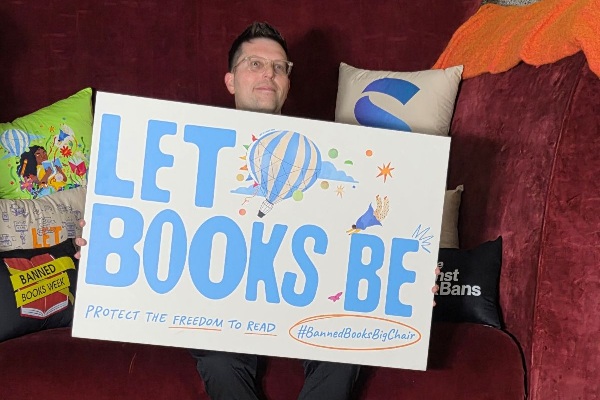
Conference attendees gathered at the Sage-sponsored “Banned Books from the Big Chair” exhibit, which we have proudly supported for more than a decade. The oversized chair once again created a space for readers, educators, library workers, and authors to celebrate challenged books and speak out against censorship.
This year, visitors heard from authors George M. Johnson, Justin Eisinger, and Arriel Vinson, and more than 400 attendees took part by reading passages from banned books, sharing personal reflections, and discussing ways to defend the freedom to read.

Above: Award-winning authors Arriel Vinson (left) and Justin Eisinger (right) read Banned Books from the Big Chair during the ALA Annual Conference in Chicago, June 2026. Photo credit: Sage
Academic Freedom and the Role of the Academic Librarian
As part of Sage’s ongoing commitment to academic freedom, we hosted a panel discussion exploring rising censorship concerns in higher education. With standing room only available, more than 100 attendees joined the conversation, which featured perspectives from Nicole A. Cooke, Augusta Baker Endowed Chair and Professor in the School of Information Science at the University of South Carolina; Christina Bell, Reference and Instruction Librarian at Glendale Community College; and Rhonda Contreras, Sage’s Director of Engagement, Library Partnerships. The panel examined what is at stake for students, faculty, and institutions, and how to respond to increasing restrictions on access to information.
At Sage, we believe that free expression in all forms is a basic human right. Learn more about our efforts to support academic freedom and access to knowledge on our Academic Freedom webpage.